
'This is not politics, it is humanity': Kollywood lines up behind the Delhi protesters
Pa Ranjith condemns the crackdown and backs Arivu, Prakash Raj reaches Jantar Mantar, and Varalakshmi and Aditi Rao Hydari add their voices for the students.
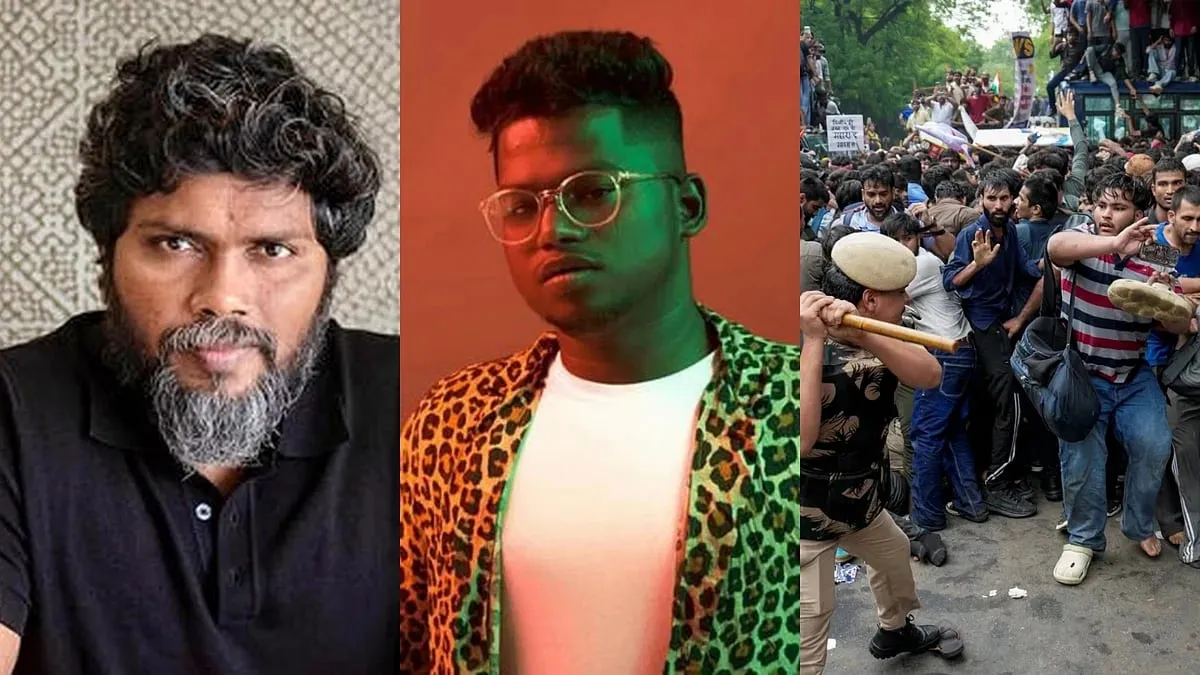
The protests at Delhi’s Jantar Mantar have pulled in a widening circle of film voices, and the way each one has chosen to speak is a story in itself. Pa Ranjith has named the government twice over. Prakash Raj flew to the site and filmed what he saw. Varalakshmi Sarathkumar apologised for taking this long. Aditi Rao Hydari refused to name a side at all and still made her point.
The protests themselves have been building for weeks. The youth-led Cockroach Janata Party movement has been demanding accountability for the alleged NEET paper leak and the resignation of Union Education Minister Dharmendra Pradhan, with activist Sonam Wangchuk on a 21-day hunger strike at Jantar Mantar until police moved him to a hospital. When protesters attempted a march towards Parliament, they were met with barricades, baton charges and tear gas, and around 70 people were arrested.
Ranjith’s first statement came the day Wangchuk was moved. “The use of force against protesters, the detention of those standing in solidarity, and the decision to move innovator and activist Sonam Wangchuk to a hospital during his 21-day hunger strike are deeply disturbing,” he wrote, arguing that repeated paper leaks and a broken examination system “have put the dreams and futures of countless students at stake,” and that the Union Education Minister and the BJP-led Union government owed the young a response “with accountability, not force.”
He returned to the subject this week with a longer statement after the police action, calling the movement “the collective anger and agitation of a generation” that refuses to accept a government “which continues to gamble with the futures of millions of young people.” He condemned the crackdown in unambiguous terms: “The brutal use of violence to crack down on peaceful protesters only exposes the government’s unwillingness to answer legitimate democratic questions. Repression cannot become a substitute for accountability.” He also singled out Arivu’s part in the anti-NEET agitation. The rapper was detained by Chennai Police for staging his own demonstration outside the Secretariat, and after his release put out a statement demanding the Union government halt the violence against students in Delhi. He also clarified that, contrary to reports, the leader he met afterwards was Minister Aadhav Arjuna, not Chief Minister Vijay.
Prakash Raj, no stranger to a political fight, went furthest. He started online, writing that the world was witnessing “a coward government” that would not engage the youth in dialogue, and following it with a Hindi jab about 56 inches of shivering nakedness behind the screen. Then he went to Jantar Mantar in person and posted video from inside the protest.
After the march was broken up, his tone changed from taunt to shock. “Witnessed authoritarian regime’s brutality on the youth of my country. Shocked and deeply disturbed. Tanashahi nahi chalegi. The country has woken up. This is just the beginning.”

Varalakshmi Sarathkumar’s post, written in Tamil, read less like a statement and more like a confession. Sometimes we sink into our own lives, she wrote, half-hearing what is happening around us and assuming problems will sort themselves out, but the videos coming out of Delhi were gut-wrenching and impossible to rationalise. “If the very people meant to protect us are attacking us, who do we go to for justice?” All the protesters were asking for, she pointed out, was a conversation about fixing education for the next generation. “We may all have different political opinions. But this is not politics, it is humanity. There are times when staying silent achieves nothing, and the time for all of us to speak up has come. Forgive me for taking this long.” She ended with a plea that lands harder than any slogan: do not let deaths become something normal.
Aditi Rao Hydari took the opposite route to the same destination, explicitly setting politics aside. “Whatever anyone’s political preferences may be, humanity must come above all,” she posted, calling for “a safe environment built on respect, dignity, and empathy for all our brave students, and for all the determined voices seeking to be heard, with a genuine commitment to constructive dialogue.” Her closing line did the work: “Meaningful progress starts with listening to one another. Our students are our future.”
Tamil cinema has circled NEET before, from message films to dramas built entirely around its human cost. What is different this week is that the industry is not processing the issue through scripts. It is speaking in first person, in real time, while the protest is still on the street.
More onPa Ranjith,Prakash Raj,CJP Protest,NEET