
Soori finished Mandaadi at sea on a fractured leg
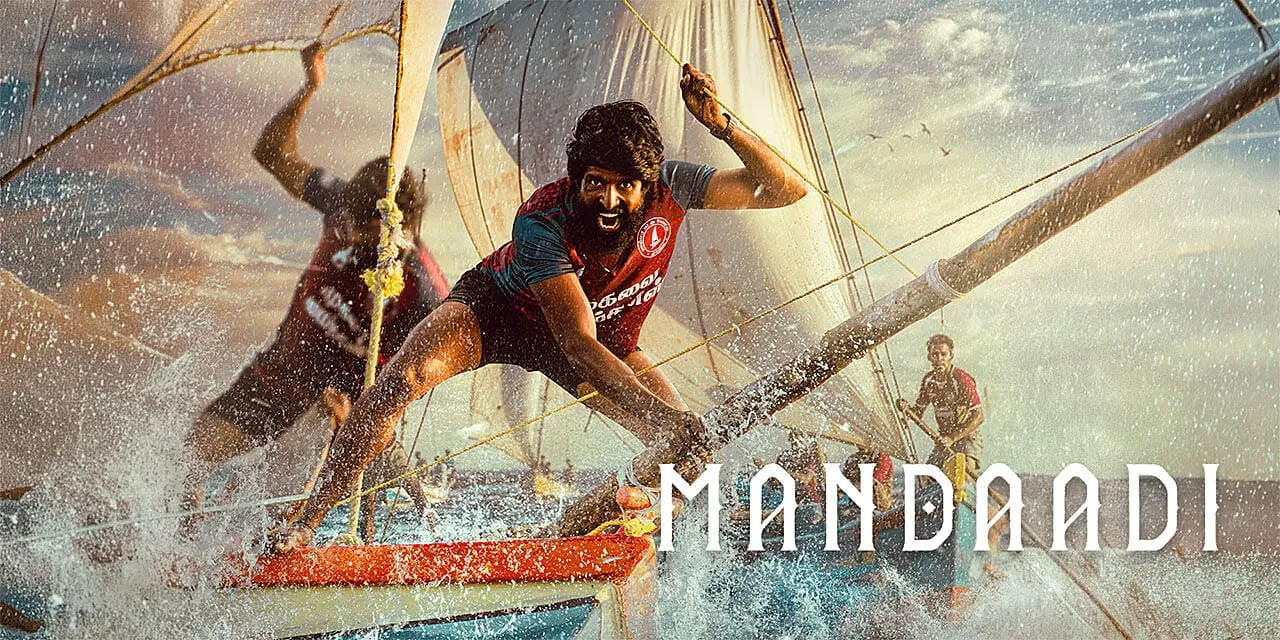
Three quarters of the film was shot 15 to 20 kilometres out on wind-powered boats, with no motors and no green screen. Mandaadi opens on September 10.
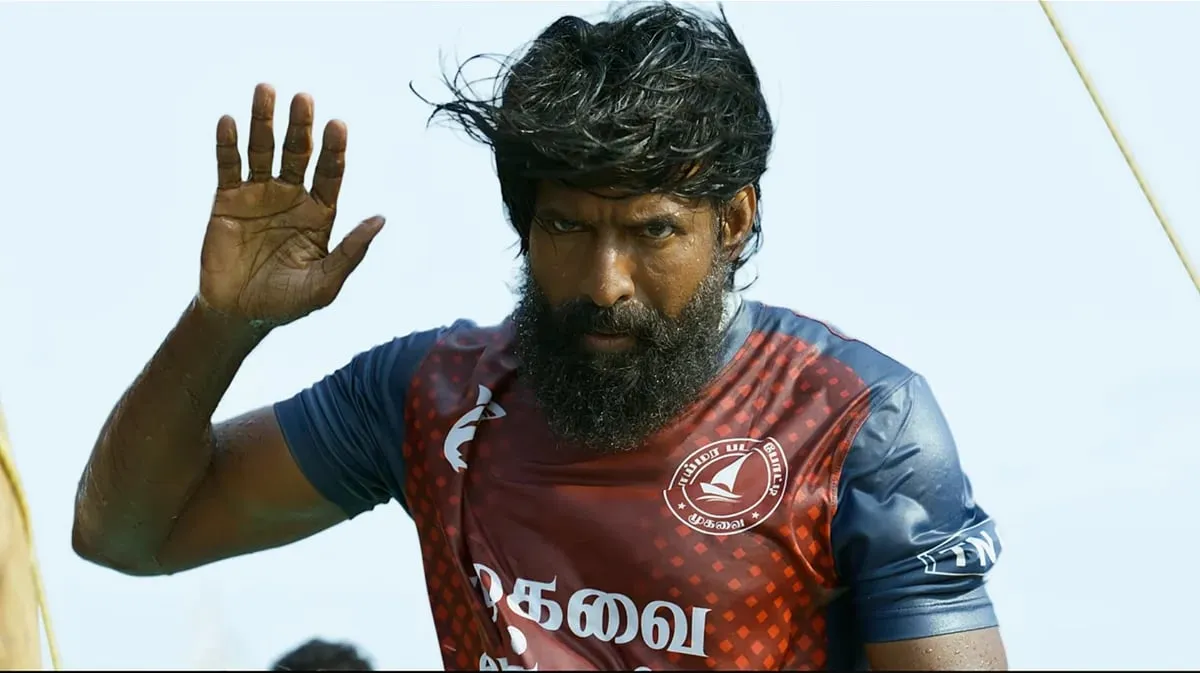
Soori spent the closing stretch of the Mandaadi shoot unable to stand. A stunt on open water left him with a fractured leg and a foot swollen past walking, and he came to set in a wheelchair. Mathimaaran Pugazhendhi told him to stop and get it treated. Soori got into the boat instead.
“It’s alright, thambi,” he told his director. “Put me in the boat, let me sit, and I’ll do whatever I can.” He finished those scenes out at sea, in the chair, without going back to shore. Peter Hein, who has been staging action for thirty-four years, said it left the entire unit staring.
Mandaadi opens on September 10.
The injury is not the strange part. The shoot is. Films that go to sea usually go for a handful of shots, and editor Pradeep E. Ragav said he assumed this one would be no different. “Most people who take a film to the sea come back beaten,” he said. “They grab a few shots on the water, put up a green mat for the rest, and finish it in CG. I thought this would be the same. They had shot the whole film on the sea.”
Peter Hein put numbers on it. The boat chase that runs through the film was shot roughly twenty kilometres out, on sailboats with no motors and no modern propulsion of any kind, moving on wind alone. Cameras were rigged onto the individual boats. On days when the weather made a single frame impossible, the producers stayed out on the water with the cast rather than putting the unit under pressure. Hein compared the conditions to standing on a battlefield, and said the extreme action sequence he had wanted to build across his career finally came together here.
Soori’s own accounting was blunter: three quarters of Mandaadi was shot fifteen to twenty kilometres into open sea. He named the Thondi boatmen who got the unit back to shore through squalls and heavy wind, Sukumar, Satheesh, Rajesh and Kalipandi, and called them the film’s lifeguards. “Without you we could not have shot a foot of this on that water.”
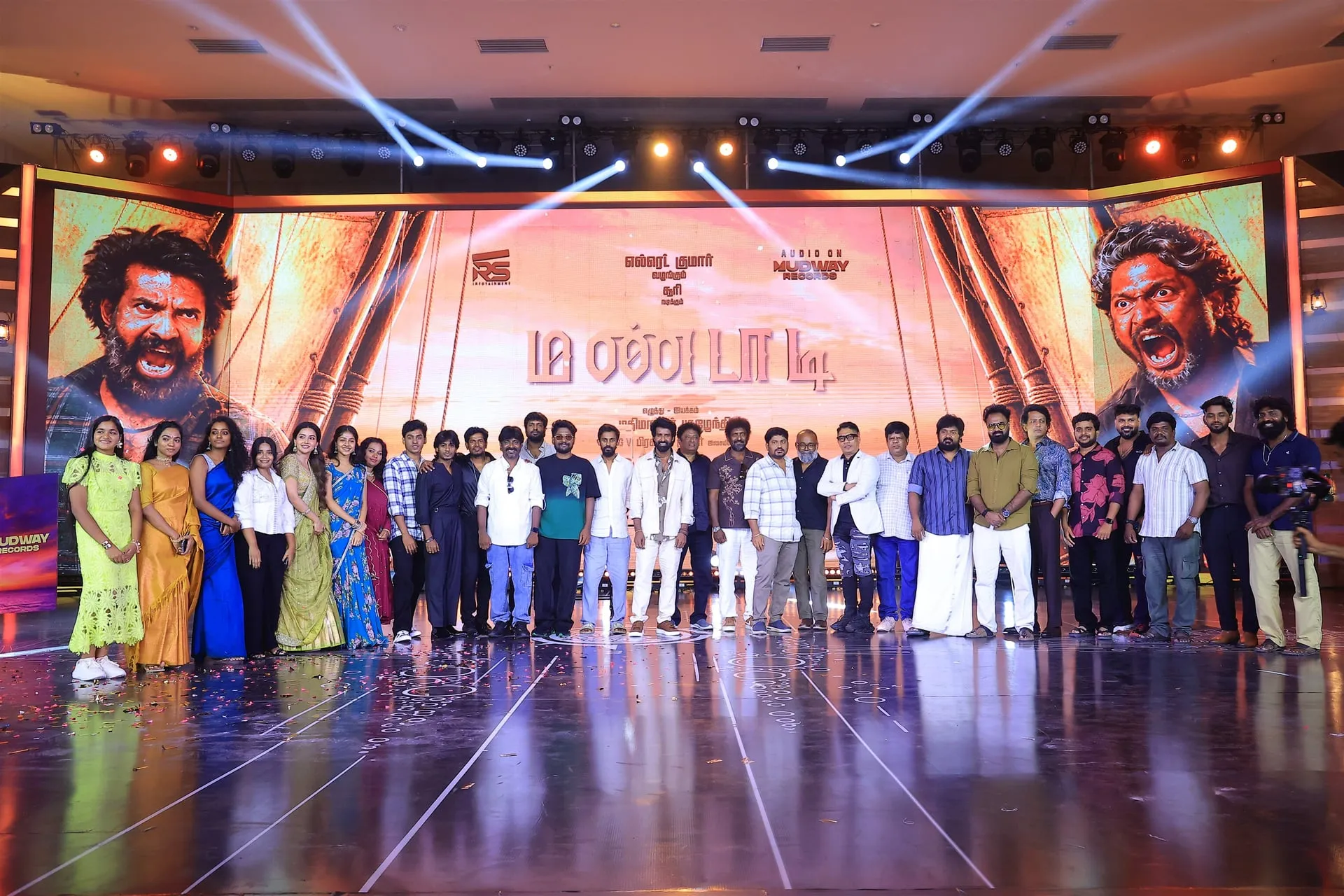
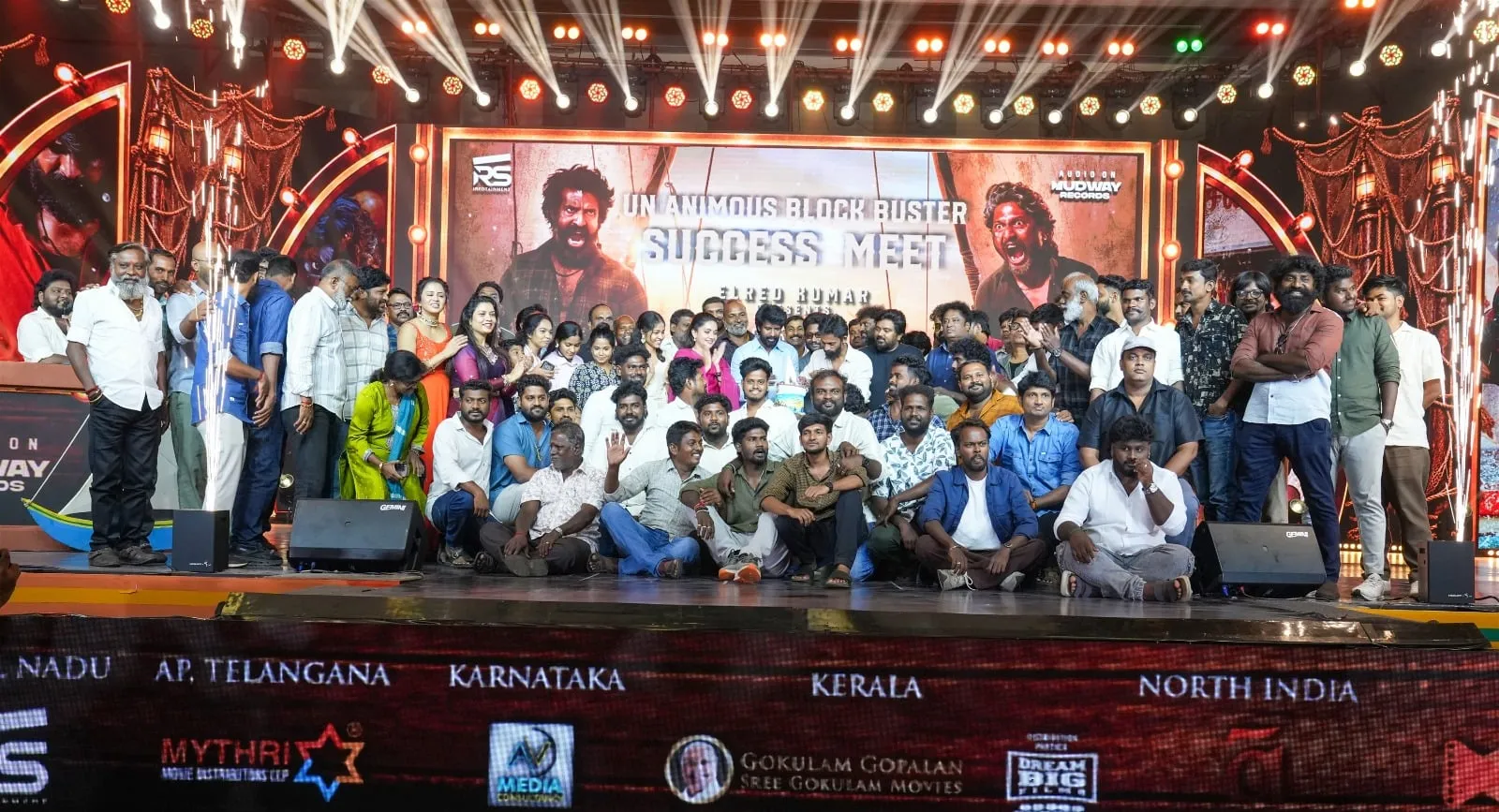
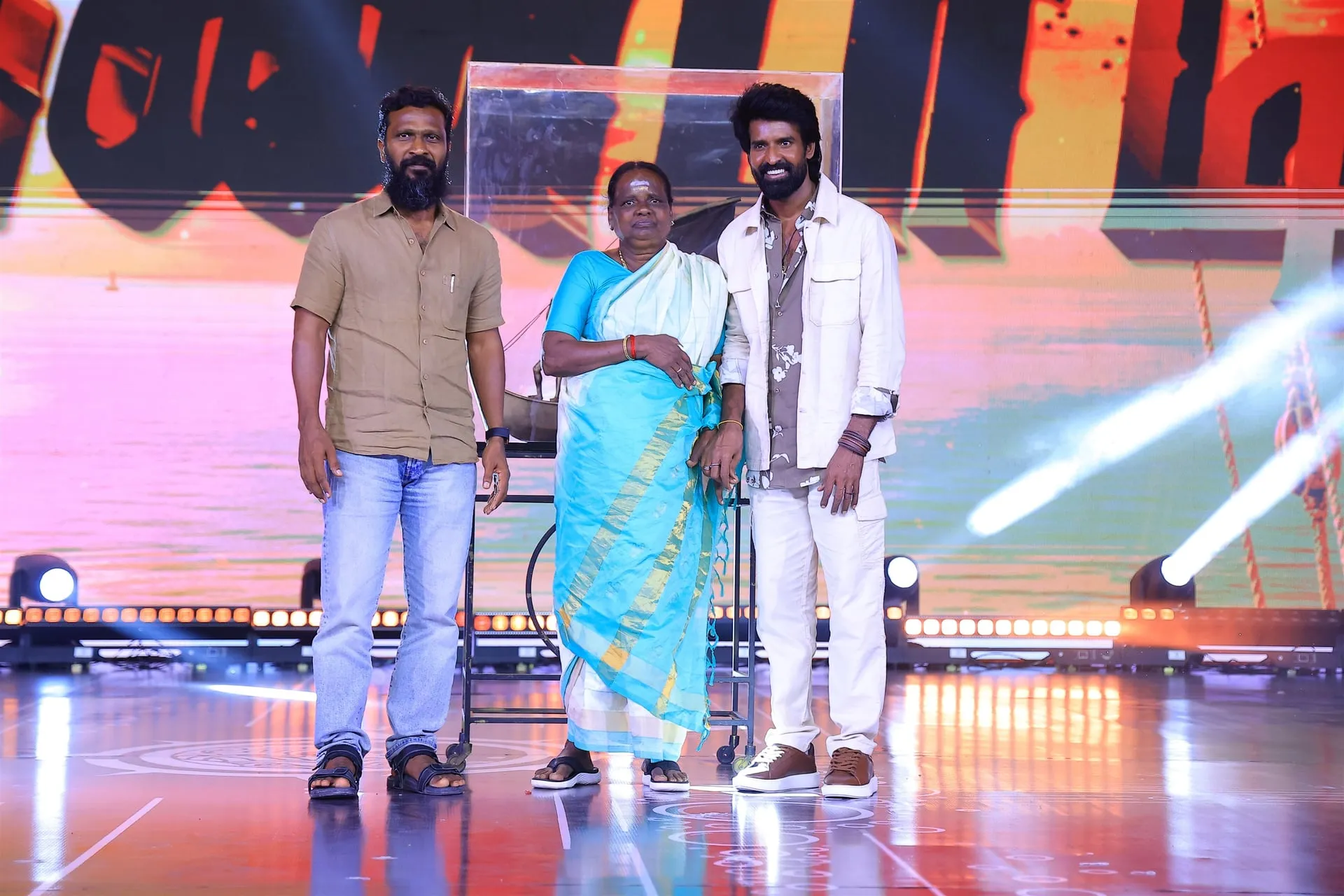
The Mandaadi cast and crew onstage after the audio launch.
Bala Saravanan supplied the anecdote that fixes what the sea did to the schedule. Soori kept acting while bleeding, he said, without pausing even to have the wound dressed. Asked why he would not take ten minutes, Soori explained that on water, resetting the boats, the camera and the lights would cost the unit half a day. “Whatever name you give to perseverance,” Bala Saravanan said, “our Soori annan is the whole shape of it. Call the film big for its budget if you like. It is more honest to call it big for the work that went into it.”
Mahima Nambiar had signed on for what was planned as a thirty-five day shoot. Fourteen-hour days in the middle of the sea followed. She singled out cinematographer S.R. Kathir for getting the depth and weight of the water onto camera, and Pradeep E. Ragav for cutting the film without letting the pace sag. Soori, she said, never once compromised a shot, however tired or knocked about he was.
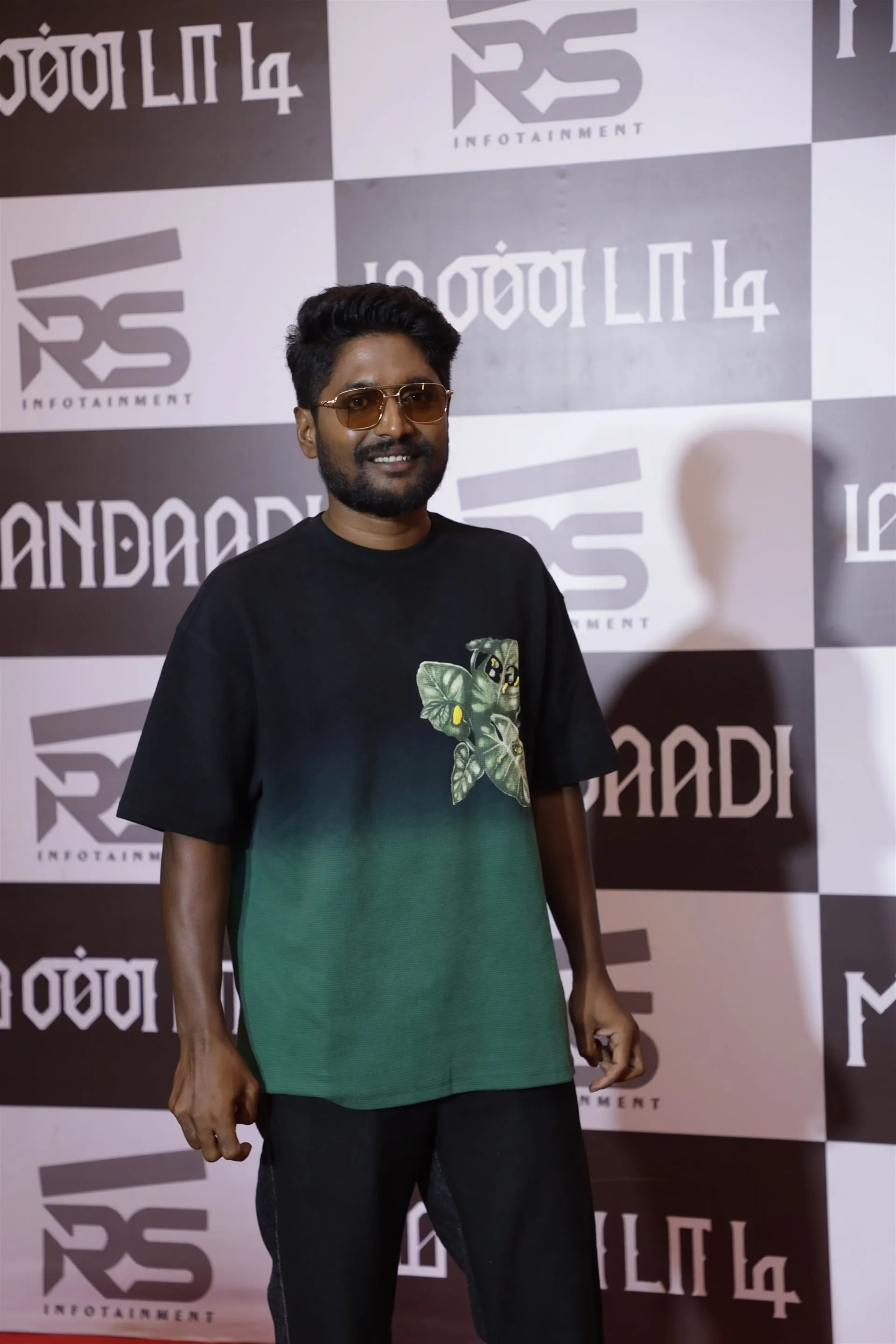

Mathimaaran Pugazhendhi put the film down to three things. Elred Kumar, who backed a director’s idea at a scale nobody had asked him for. The sea, which is what sent him hunting for someone rooted in the Rameswaram coast and led him to producer Mani, who kept deadlines and pressure off him for the whole schedule. And Soori, whom he called the film’s lifeblood, with an apology attached in case the shoot had stopped him looking after his lead properly.
He described the working relationship as an arranged marriage that turned into love. Early on he noticed Soori turning up each morning on no sleep. Asked about it, Soori said the town was new to him. The second night, the same answer. On the third day an assistant director told the director the truth: the actor was staying up over the work, and the director was the reason.
He was equally candid about the job of directing technicians senior to him. “There were always people like Peter Hein master and Kathir sir around me. I put Peter master through a lot.” When Kathir worried about losing a camera into the water and wanted a safer angle, he drew the setup out like a professor until he found a way to give Mathimaaran the shot he had in his head.
Vetrimaaran, who is a creative producer on the film, opened by explaining the family thread: Mathimaaran’s father is the man who gave him the name Vetrimaaran, which makes the two of them cousins. What he wanted on record was that the connection bought nothing. Mathimaaran shot a short film first and screened it before asking for the assistant’s job, because the work had to stand on its own before anything else did. Later, through the post-production of Viduthalai, what struck Vetrimaaran was the commitment and the clarity about the script. Mandaadi, he said, is not only a sports drama; it is a film about what people carry.
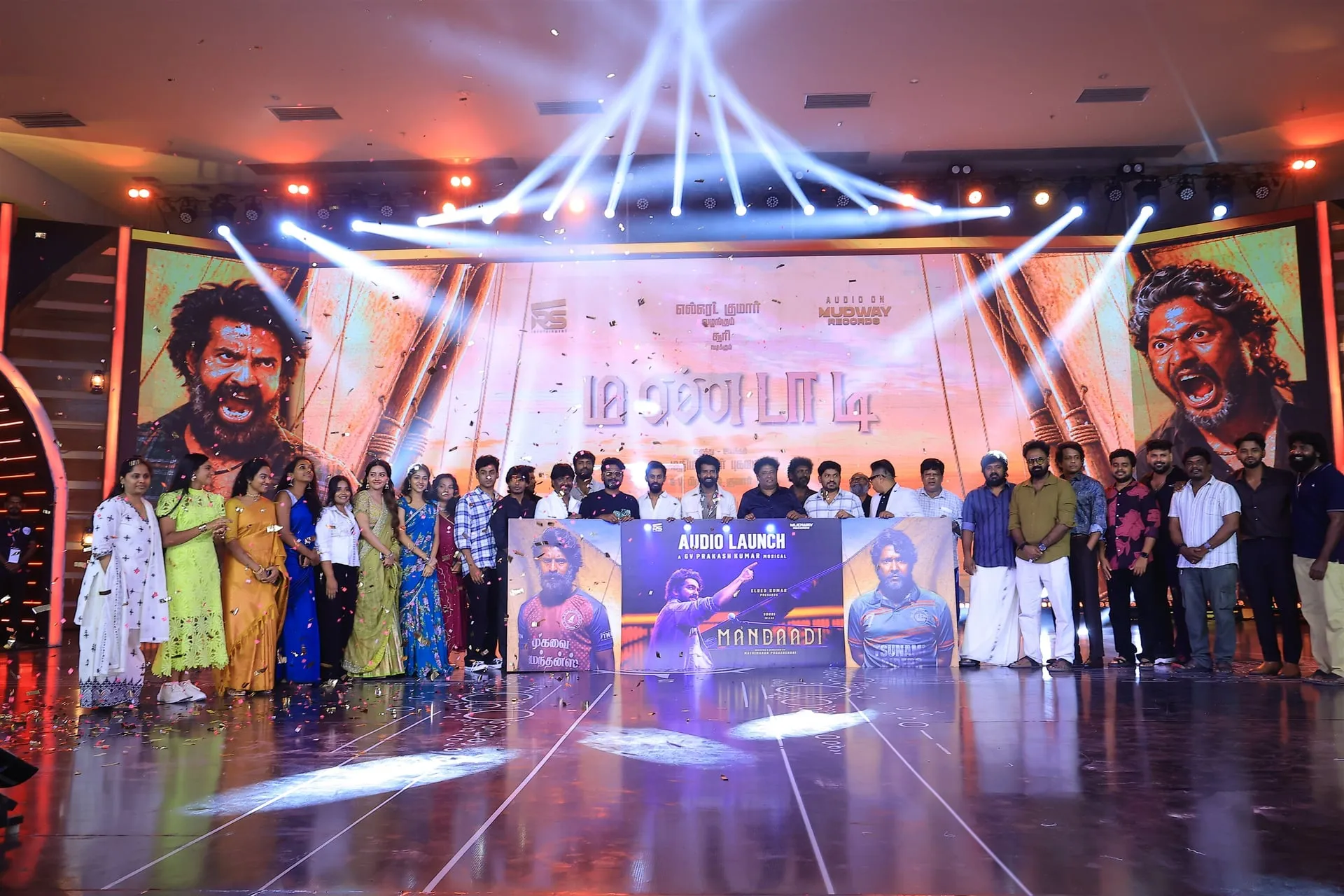
The Mandaadi team onstage with the audio launch banner.
G.V. Prakash Kumar, who has known the director since Udhayam NH4, said the work ethic and the depth of the reading will push Mathimaaran into the front rank of Indian directors soon enough, and that Elred Kumar had mounted the film at a cost nobody expected. Soori returned the compliment about his producer with the line the room kept repeating: ask for five hundred junior artistes and Elred Kumar sends fifteen hundred. He also named what the casting of Suhas is banking on, welcoming the actor to Tamil cinema on the strength of a face that reads innocent from one side and menacing from the other.
Mithun Jai Shankar had two films behind him and a director who told him upfront that he had seen neither, and cast him anyway. What stayed with him was the climax stretch, where Soori took the worst of the impacts and the younger actors came away with smaller injuries. When the rest of them were spent, he said, Soori showed no sign of flagging, and that was where they found the energy to keep going.
RJ Balaji came only because of Soori, and said so. Then he produced the frame that gives the evening its measure. In Sangamam, in 1999, Vijayakumar’s car comes through a gate and ten men get knocked aside. One of them goes flying. That was Soori. Balaji’s count was twenty-five years from that shot to the top of a poster, through work as a junior artiste, an electrician, a carpenter and a comedian, and his point was that Soori took the space from nobody. “Anybody can paste up their own posters. The love has to come from people.”
The posters were on Balaji’s mind because they were everywhere that morning, for Soori’s birthday. They were on Soori’s mind too. His mother had called him two days earlier and cried down the phone, he said, reminding him of the day he rang her in tears because he could not find three hundred rupees for house rent and had no way to eat. “Today I see your birthday posters across the whole town.” Her tears and her blessing, he said, are what keep him going, along with his wife and children.
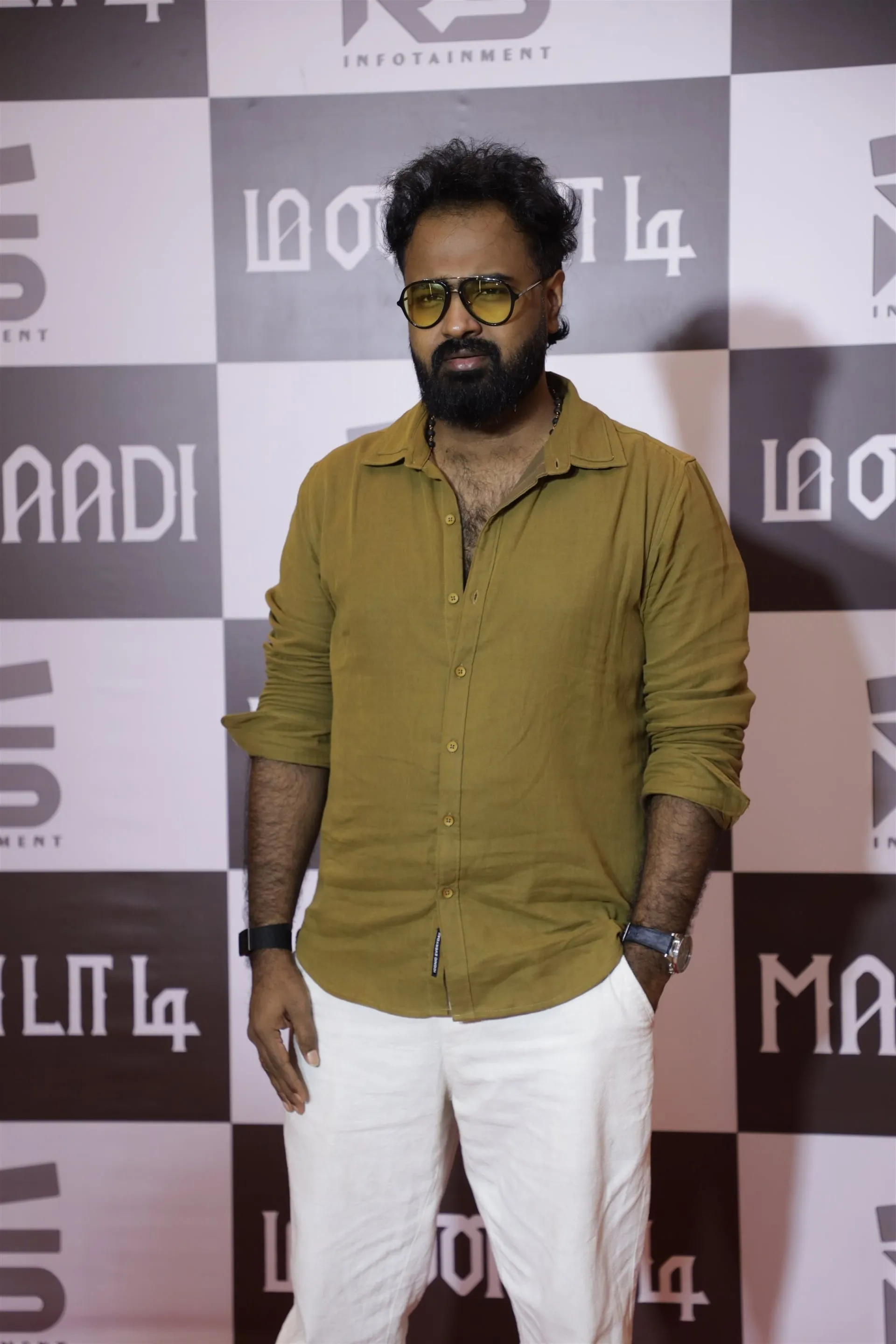
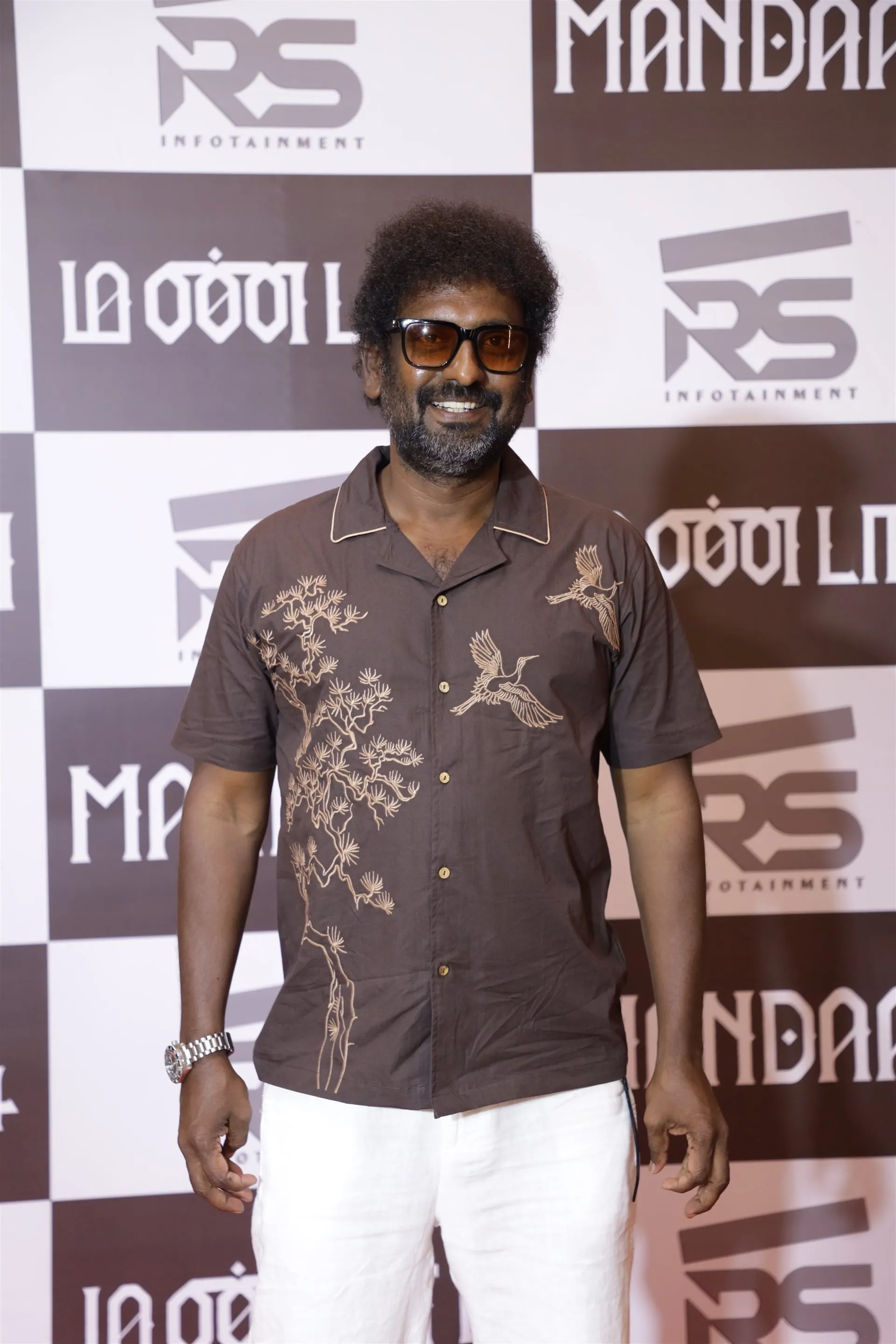
Mandaadi takes its title from the man who reads currents, wind and swell and leads a sailboat crew. Sathyaraj, Mahima Nambiar, Suhas, Ravindra Vijay, Bala Saravanan, Mithun Jai Shankar and Kirthika fill out the cast around Soori, with music by G.V. Prakash Kumar, camera by S.R. Kathir, cutting by Pradeep E. Ragav, action by Peter Hein alongside Mahesh Mathew and Dhilip Subbarayan, and production design by D.R.K. Kiran, produced by Elred Kumar for RS Infotainment. Mathimaaran first announced the film in April last year.
He closed on the thing he actually wants out of it. Jallikattu is recognised as a heritage sport in Tamil Nadu; the fishermen’s sailboat race, he argued, is exactly the same kind of inheritance and has none of the same standing. His ask is that the state and the centre give it awards and formal recognition. If that happens, he said, he will count it as the biggest thing Mandaadi ever did.
More onMandaadi,Soori,Vetrimaaran,Mathimaaran Pugazhendhi